
“My arms aren’t long enough anymore.”
“I have to hold my phone farther away.”
"Small print is getting harder to read."
“I need glasses for distance AND up Close.”
“I’m constantly taking my glasses on and off.”
“My progressive lenses drive me crazy.”
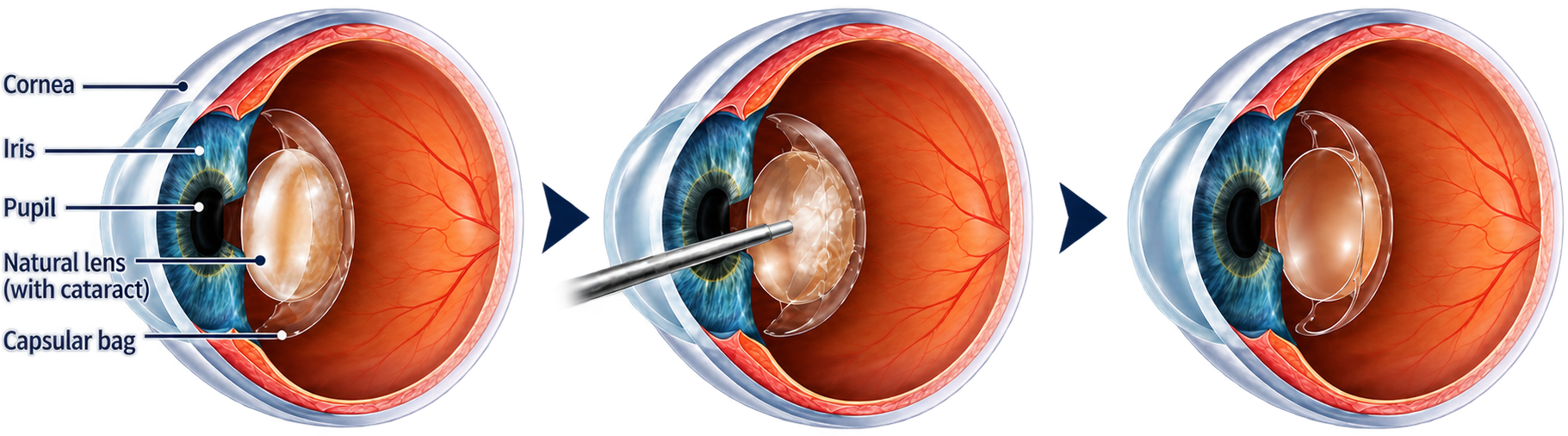
Your eye’s natural lens is located behind the iris and helps focus light, allowing you to see clearly at different distances.
Through a tiny incision, the natural lens is gently removed using advanced technology while the capsular bag is preserved.
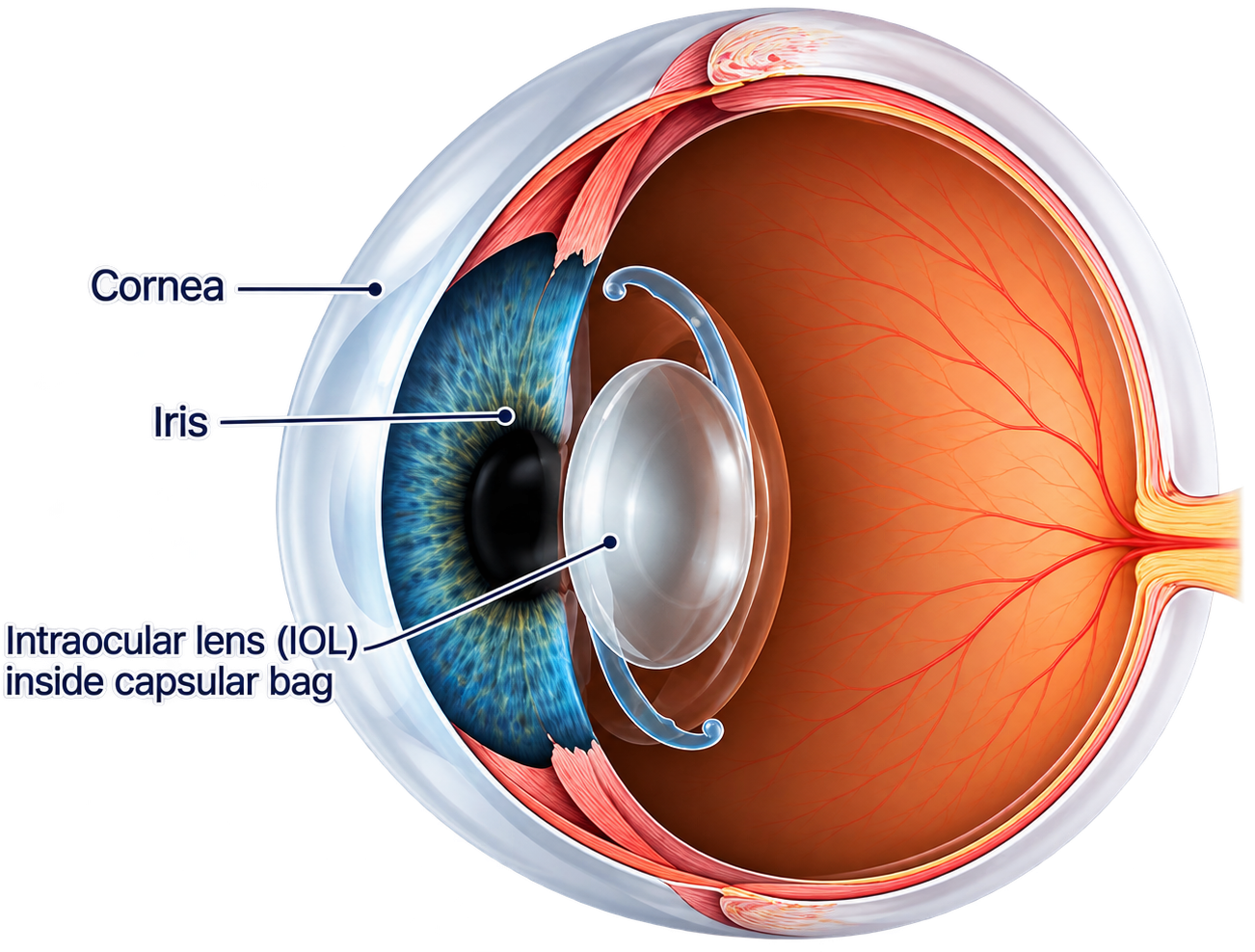
1. An advanced intraocular lens (IOL) is positioned inside the capsular bag to provide the new focusing power for clear vision.
No future risk of cataract in the eye after lens replacement.
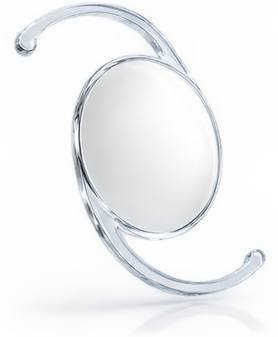
Custom Lens Replacement, also known as Refractive Lens Exchange (RLE) or Clear Lens Exchange (CLE), replaces the eye’s natural lens with an artificial intraocular lens (IOL) selected around your vision needs and goals.
The surgical process is essentially the same approach used for cataract surgery, but Custom Lens Replacement is performed for refractive and vision-correction purposes before a visually significant cataract requires surgery.
Depending on the lens selected and patient candidacy, Custom Lens Replacement may address:
One personalized goal: finding the vision correction option best suited to your eyes.
When we’re younger, the natural lens can change shape to help the eye focus at different distances. As the lens becomes less flexible with age, focusing up close becomes more difficult.
This is why readers, bifocals and progressive lenses often enter the picture.
Vision correction isn’t just for your 20’s and 30’s.
Designed to reduce dependence on glasses or contacts.
Different lens technologies allow vision to be tailored around the patient’s eyes, lifestyle and priorities.
Depending on lens selection and candidacy, Custom Lens Replacement may provide a greater range of vision.
No future risk of cataract in the eye after lens replacement.
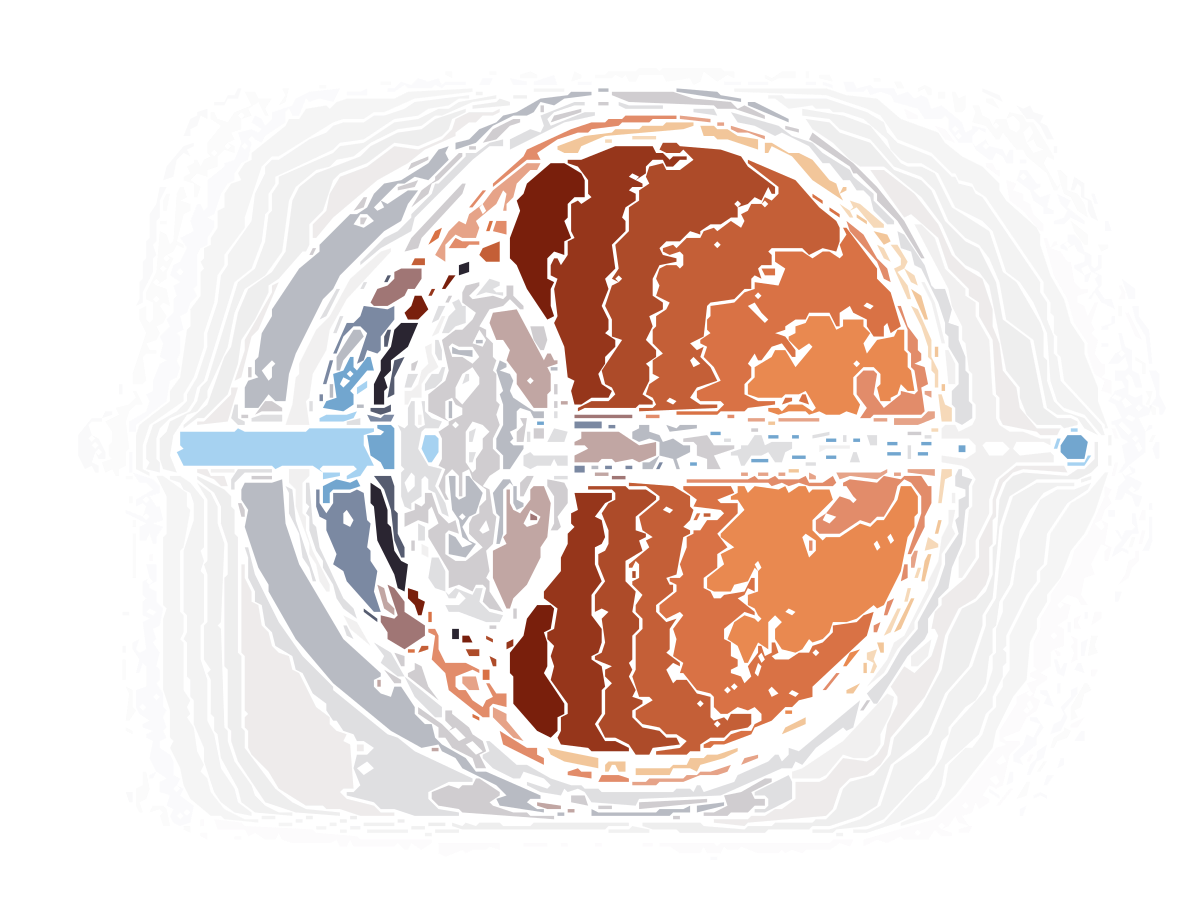
Generally optimized for one primary focal distance. Patients choosing distance correction will typically still need glasses for intermediate and near vision.
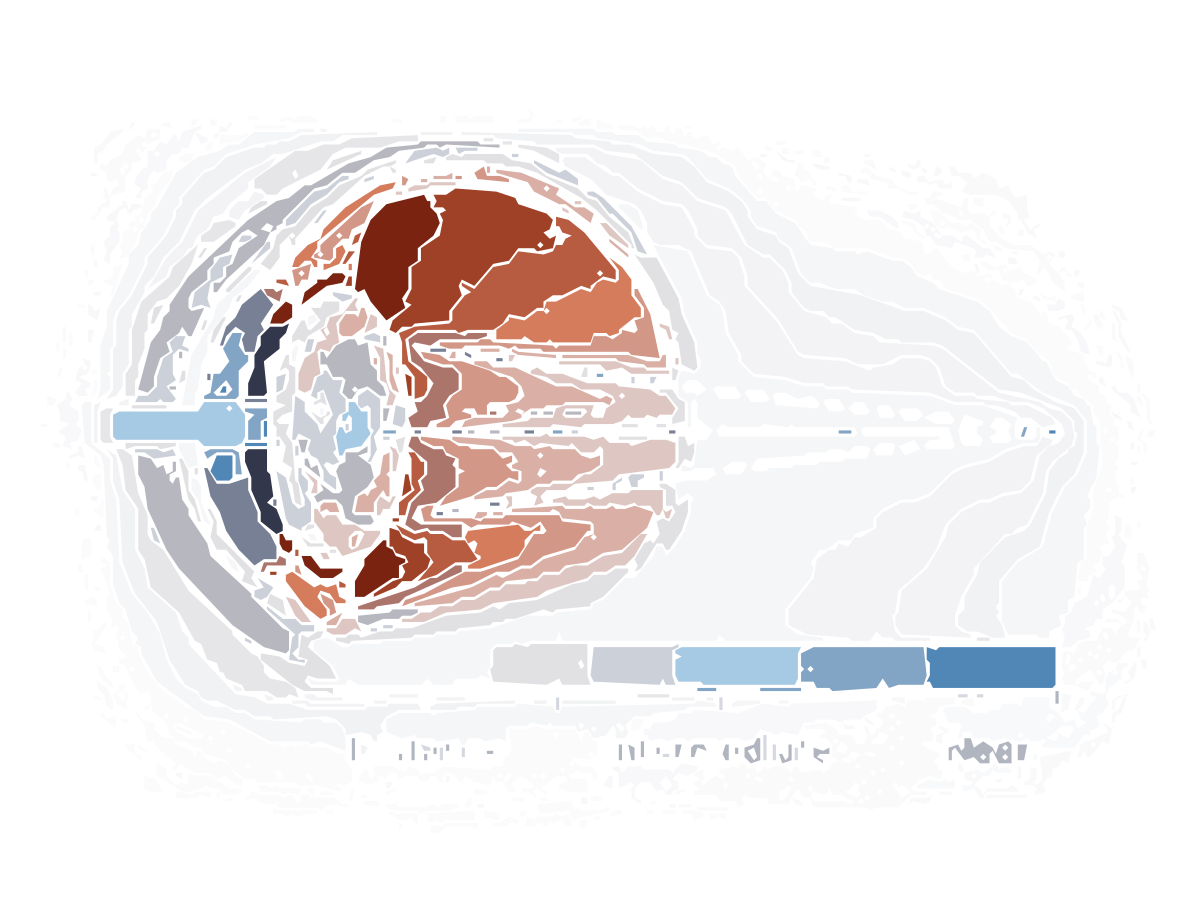
Designed to provide an extended range of functional vision, particularly at distance and intermediate ranges. Some near vision may be possible, although readers may still be needed for small print.
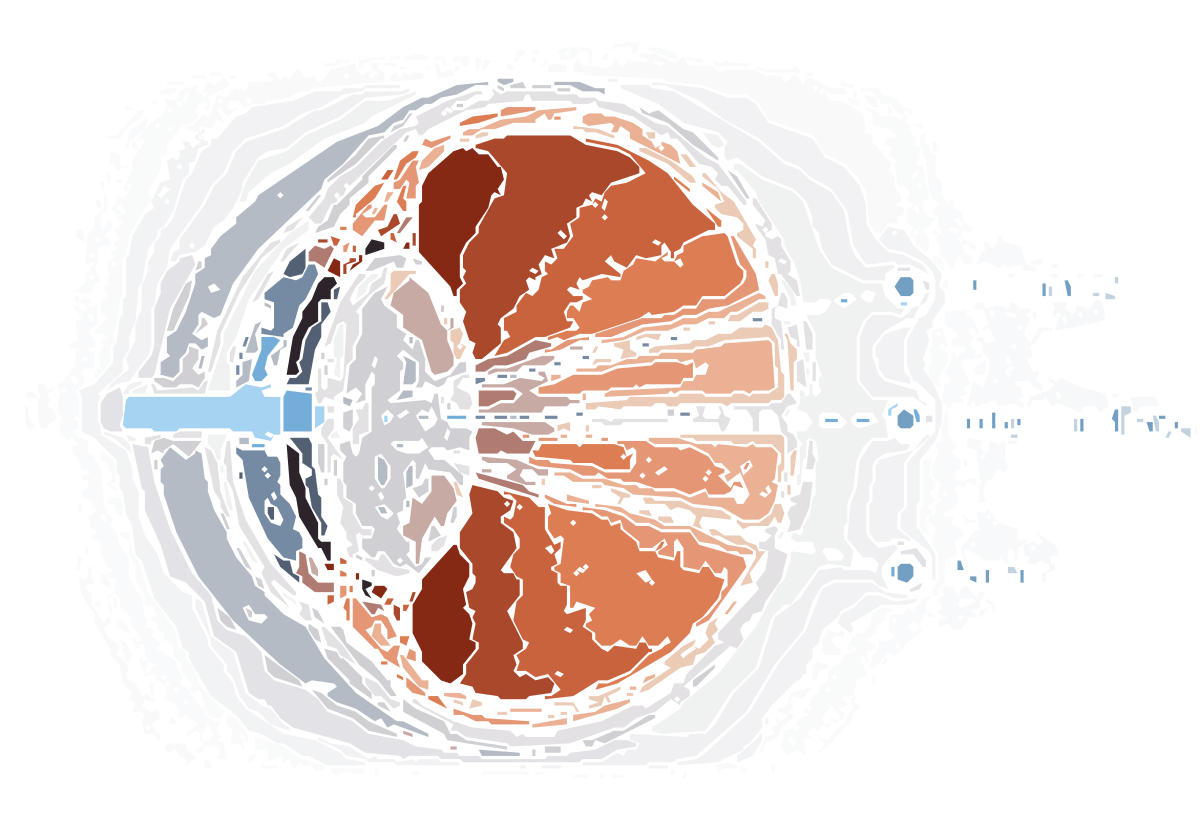
Designed to provide vision across distance, intermediate, and near ranges, with the goal of reducing dependence on glasses.
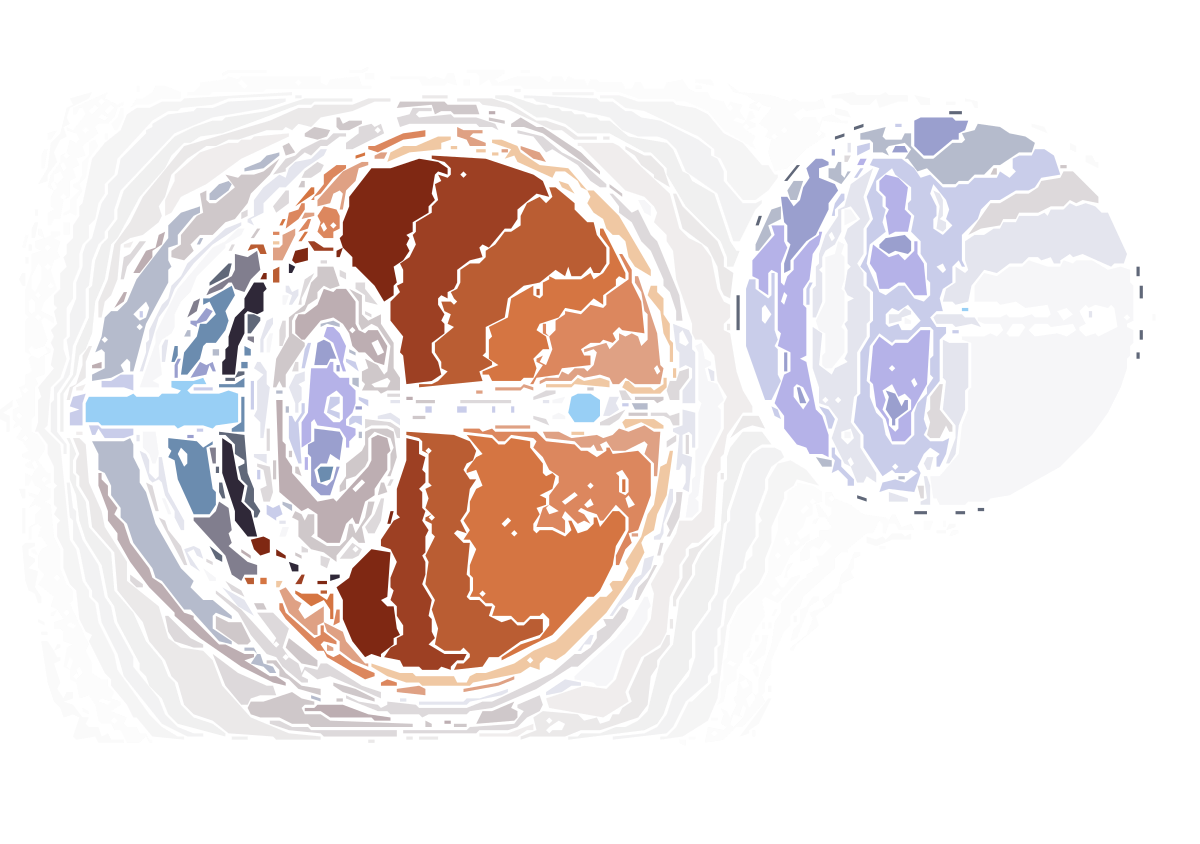
Allows the refractive result to be customized after surgery through a series of postoperative light treatments.
The natural lens has become cloudy enough that cataract removal is medically indicated.
The natural lens may still be relatively clear but is replaced primarily for refractive and vision-correction purposes. Custom Lens Replacement allows appropriate patients to address their refractive error and aging natural lens without waiting for a cataract to become visually significant.
Custom Lens Replacement is generally considered an elective refractive procedure and is typically not covered by insurance when performed solely for vision correction.
When you come to Sawyer Eye Center looking for greater visual freedom, our goal isn’t to steer you toward a particular procedure.
We evaluate your entire eye, your prescription, your lifestyle and your visual goals to determine which vision correction option makes the most sense for you.
For some patients, that may be Laser Vision Correction (PRK, SMILE, LASIK). For others, it may be EVO ICL or Custom Lens Replacement.
1. Custom Lens Replacement, also known as Refractive Lens Exchange (RLE) or Clear Lens Exchange (CLE), is a vision correction procedure that replaces the eye’s natural lens with an artificial intraocular lens (IOL) selected around your vision needs and goals. Depending on the lens selected, it may reduce dependence on reading glasses, bifocals, progressive lenses, and distance glasses.
The procedure is similar to cataract surgery, but it is performed for refractive and vision-correction purposes before a visually significant cataract requires surgery. Because the natural lens is removed and replaced, a cataract cannot later develop in that eye.
2. Custom Lens Replacement and cataract surgery use a very similar surgical approach. In both procedures, the eye’s natural lens is removed and replaced with an artificial intraocular lens (IOL).
The main difference is why the procedure is performed. Cataract surgery is performed when the natural lens has become cloudy enough to affect vision, while Custom Lens Replacement is performed primarily to correct vision and address the aging natural lens before a visually significant cataract develops. Once the natural lens has been replaced, a cataract cannot develop in that eye.
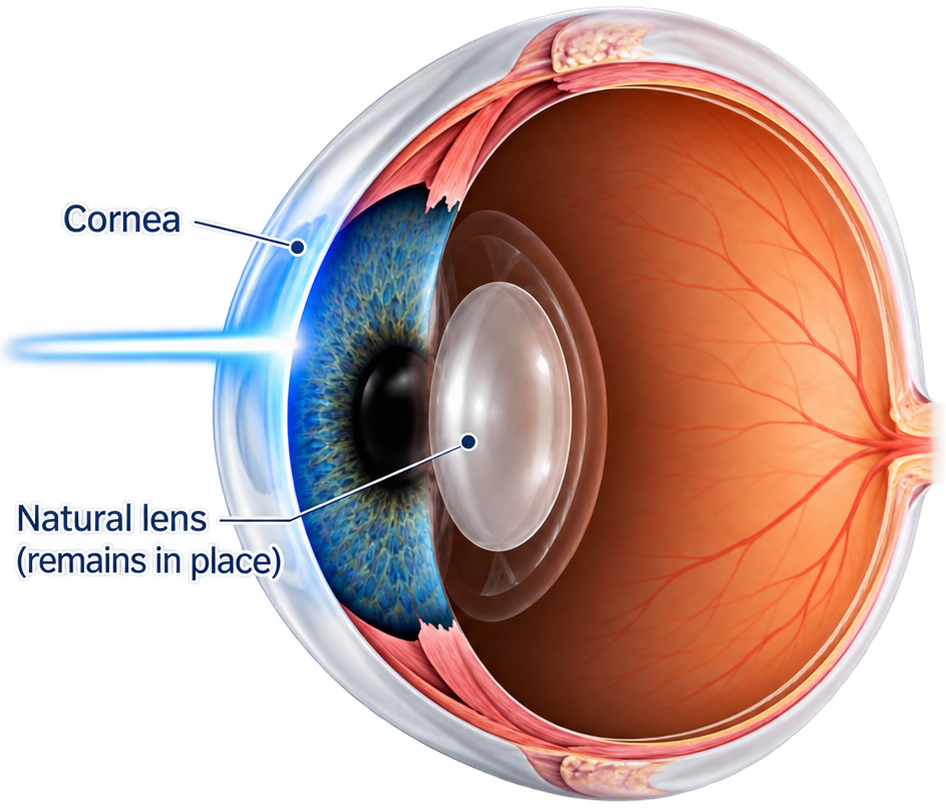
Laser Vision Correction, including PRK, SMILE, and LASIK, corrects vision by reshaping the cornea while leaving the eye’s natural lens in place. Custom Lens Replacement takes a different approach by removing the natural lens and replacing it with an artificial intraocular lens (IOL).
Laser Vision Correction may be appropriate for many patients depending on their prescription, age, and eye health. Custom Lens Replacement may be considered for patients experiencing age-related changes in the natural lens, such as presbyopia, or whose eyes may be better suited to a lens-based procedure.
Not necessarily. Age alone does not determine whether you are a candidate for LASIK, PRK, SMILE, or another vision correction procedure. However, as we move into our 40s and beyond, the natural lens gradually loses its ability to focus up close, a normal age-related change known as presbyopia.
For some patients, Custom Lens Replacement may be a more appropriate long-term option because it addresses the aging natural lens rather than correcting only the cornea. A comprehensive eye examination and diagnostic testing are needed to determine which option is best suited to your eyes.
Custom Lens Replacement may be an option for adults, often in their 40s and beyond, who are becoming increasingly dependent on readers, bifocals, or progressive lenses and would like to reduce their dependence on glasses or contacts.
Your prescription, overall eye health, lifestyle, visual goals, and the condition of your natural lens all help determine whether Custom Lens Replacement is appropriate for you. A comprehensive consultation is necessary to determine candidacy.
Astigmatism can often be addressed during Custom Lens Replacement with a toric intraocular lens or other astigmatism-correcting techniques.
The amount and type of astigmatism you have, along with your overall eye health and visual goals, will help your surgeon determine which lens or treatment approach is most appropriate for your eyes.
Yes. Depending on the intraocular lens selected, Custom Lens Replacement may provide a broader range of vision and significantly reduce dependence on reading glasses.
Different lens technologies are designed to provide different ranges and qualities of vision. No lens can guarantee complete freedom from glasses for every activity, so your surgeon will recommend an option based on your eyes, lifestyle, and visual goals.
No. A cataract develops when the eye’s natural lens becomes cloudy. During Custom Lens Replacement, the natural lens is removed and replaced with an artificial intraocular lens, so a cataract cannot later develop in that eye.
Some patients may eventually develop cloudiness of the capsule behind the lens implant, called posterior capsule opacification (PCO). PCO is different from a cataract and can typically be treated with a quick in-office laser procedure.
There is no single intraocular lens that is best for everyone. Different lens technologies can provide different ranges and qualities of vision, and the best choice depends on your eye health, prescription, lifestyle, and visual priorities.
During your evaluation, we’ll discuss how you use your vision every day, including activities such as driving, reading, computer work, and hobbies, and help determine which lens technology best matches your needs and goals.
The Light Adjustable Lens (LAL) is a unique intraocular lens that allows the refractive result to be customized after the lens has been implanted.
Once the eye has healed sufficiently, a series of specialized light treatments are used to adjust the lens power and fine-tune the visual result. During the adjustment period, patients must follow the prescribed postoperative instructions, including wearing UV-protective glasses as directed until the adjustment and lock-in treatments are complete. This process allows the eye care team to refine the lens power after surgery before the final result is locked in.
Custom Lens Replacement is generally considered an elective vision correction procedure and is typically not covered by medical insurance when performed solely for refractive purposes.
Financing options may be available to help make treatment more manageable. Our team can review pricing, financing, and available payment options with you before you make any treatment decisions.
You don’t have to determine that on your own. Laser Vision Correction (PRK, SMILE, LASIK), EVO ICL, and Custom Lens Replacement correct vision in different ways, and the best option depends on much more than your age or prescription.
During your consultation, we’ll evaluate your eyes, prescription, lifestyle, natural lens, and visual goals to determine which procedure or procedures you may be a candidate for. We’ll also help you understand the potential advantages, limitations, and tradeoffs of each option so you can make an informed decision.
Your eyes, lifestyle and visual goals are unique. A comprehensive consultation at Sawyer Eye Center can help determine which vision correction option is best suited to you.